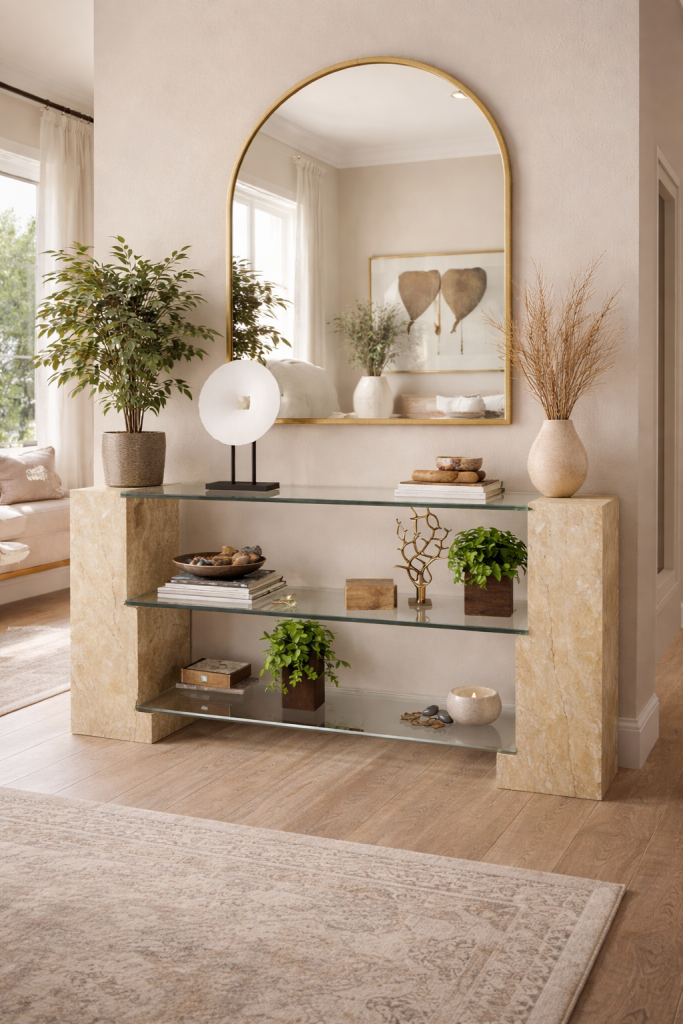
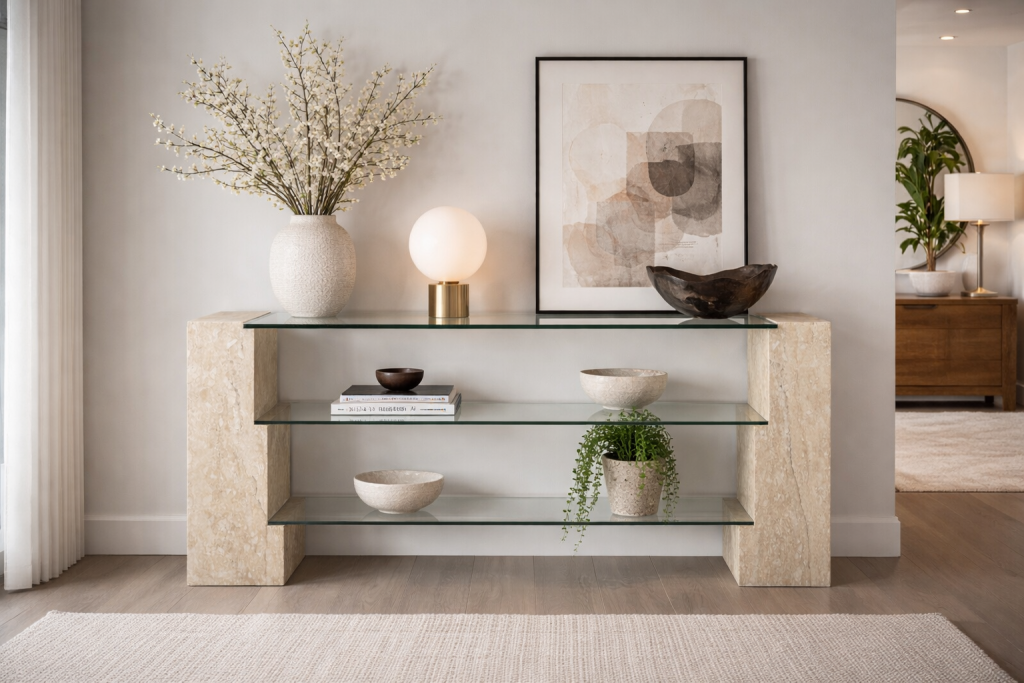
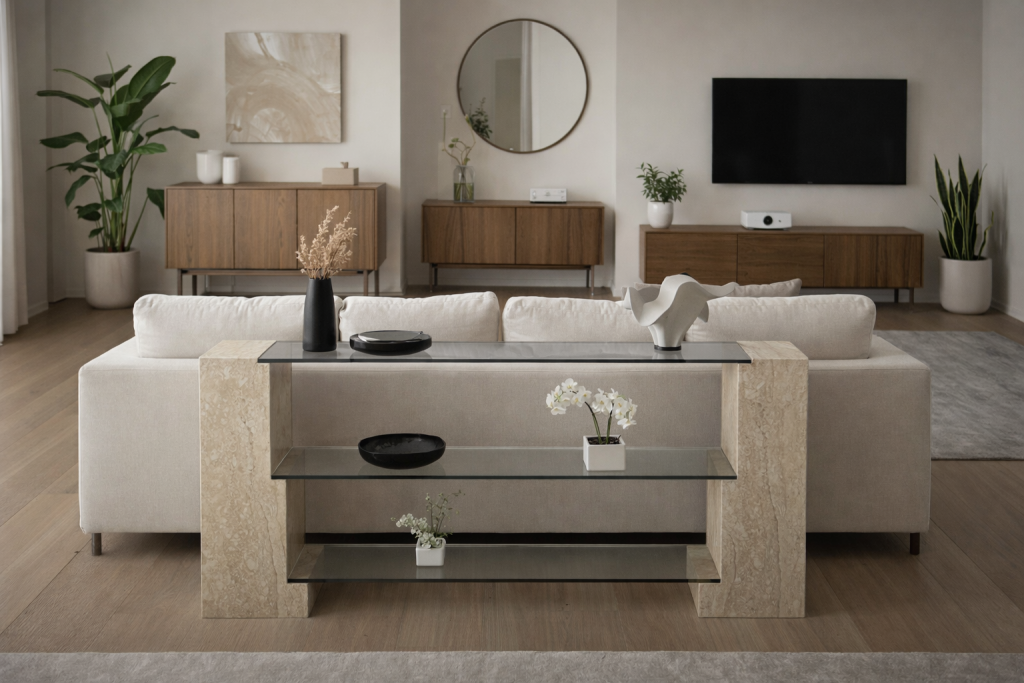
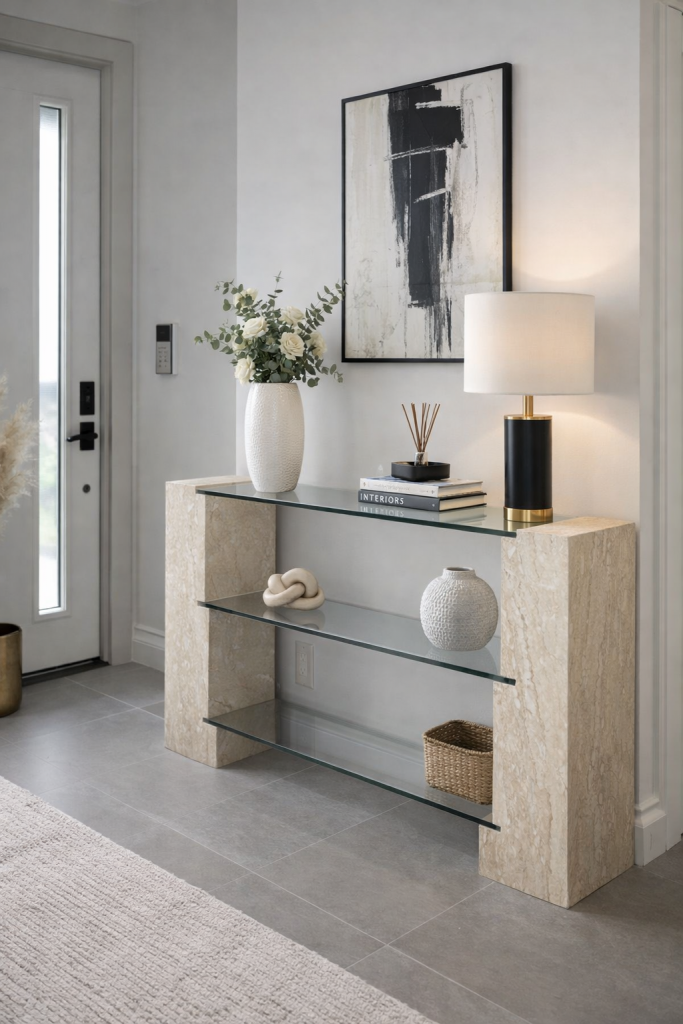
The Escala console table draws on the serene presence of travertine marble. Its warm tones and slightly porous texture convey a sense of natural balance, allowing it to blend smoothly into different architectural contexts. Each pedestal reveals the nobility of the material without artifice, letting the stone express its character with honesty. Travertine acts not as a simple support, but as a structural element that defines the identity of the piece.
The composition is organized around two pedestals located at either end. This lateral arrangement creates a solid frame that frees up the center and creates a sense of visual spaciousness. The contained symmetry provides stability, while the separation between the two volumes introduces rhythm and lightness. The stone, anchored to the ground, supports the whole with a firm, architectural presence.
Three central glass panels emerge from the pedestals in a staggered arrangement. This gesture introduces dynamism and depth, creating a visual sequence reminiscent of an upward progression. The transparent planes allow light to pass through the piece, softening the weight of the marble and lending it a contemporary feel. The staggered overlap is not merely decorative: it organizes the space and expands the possibilities for use.
Escala works naturally as a console table in a hallway, providing an elegant surface for everyday objects. It also adapts as an occasional piece in a living room or as a room divider in open-plan spaces, where its structure allows it to define areas without closing them off. The transparency of the glass maintains the visual connection between areas, while the pedestals provide the necessary solidity to structure the environment.
The Escala console table is the result of a precise search for balance between substance and lightness. The contrast between travertine and glass creates a versatile piece that can transform a space without overwhelming it. It is a design that combines architectural presence and real functionality, conceived to coexist with contemporary architecture through its sobriety and formal clarity.
The Escala console table draws on the serene presence of travertine marble. Its warm tones and slightly porous texture convey a sense of natural balance, allowing it to blend smoothly into different architectural contexts. Each pedestal reveals the nobility of the material without artifice, letting the stone express its character with honesty. Travertine acts not as a simple support, but as a structural element that defines the identity of the piece.
The composition is organized around two pedestals located at either end. This lateral arrangement creates a solid frame that frees up the center and creates a sense of visual spaciousness. The contained symmetry provides stability, while the separation between the two volumes introduces rhythm and lightness. The stone, anchored to the ground, supports the whole with a firm, architectural presence.
Three central glass panels emerge from the pedestals in a staggered arrangement. This gesture introduces dynamism and depth, creating a visual sequence reminiscent of an upward progression. The transparent planes allow light to pass through the piece, softening the weight of the marble and lending it a contemporary feel. The staggered overlap is not merely decorative: it organizes the space and expands the possibilities for use.
Escala works naturally as a console table in a hallway, providing an elegant surface for everyday objects. It also adapts as an occasional piece in a living room or as a room divider in open-plan spaces, where its structure allows it to define areas without closing them off. The transparency of the glass maintains the visual connection between areas, while the pedestals provide the necessary solidity to structure the environment.
The Escala console table is the result of a precise search for balance between substance and lightness. The contrast between travertine and glass creates a versatile piece that can transform a space without overwhelming it. It is a design that combines architectural presence and real functionality, conceived to coexist with contemporary architecture through its sobriety and formal clarity.